
Cybersecurity Meets K9 Security: Protecting the Modern Data Center
Many new data centers are being built across the United States to support the explosive growth of artificial intelligence (AI), cloud computing, and digital services. As these state-of-the-art facilities come online, an important question arises: Has enough attention been given to protecting their physical perimeter? While data center operators invest heavily in protecting their facilities against cyberattacks, cybersecurity extends beyond electronic networks. It also depends on protecting the physical infrastructure that houses the servers, networking equipment, and critical systems. This article examines the unique security challenges facing modern data centers and explains why an effective security strategy must integrate both cybersecurity and layered physical perimeter security.

Cybersecurity is also a physical security
Cybersecurity professionals increasingly recognize that digital and physical security are inseparable. While most cyberattacks originate remotely, unauthorized physical access can enable attackers to bypass or undermine cybersecurity controls. Industry surveys show that physical access weaknesses such as tailgating remain a significant concern, and insider threats continue to challenge organizations worldwide. An attacker who gains access to telecommunications rooms, network equipment, maintenance areas, or other critical infrastructure may be able to connect unauthorized devices, tamper with communications equipment, steal sensitive information, or disrupt operations. For this reason, modern data center security strategies increasingly integrate cybersecurity with layered physical perimeter security.
To illustrate this point, please consider the following statistics:
- 83% of organizations reported insider attacks in 2024. Insider threats often involve individuals with authorized physical access to facilities or systems, illustrating the importance of securing both people and physical environments.
- More than 70% of security professionals consider their facilities vulnerable to physical tailgating. Tailgating—an unauthorized person following an authorized individual into a secure area—is one of the most common physical security weaknesses in data centers and other critical facilities.
- Surveys have found that 66% of organizations experienced a physical security breach within the past two years. Common causes included tailgating, propped-open doors, and other physical access failures.
- The global data center physical security market is projected to grow from approximately $2.7 billion in 2026 to more than $7 billion by 2033. That growth reflects increasing recognition that protecting data centers requires investment in both cyber and physical security
Data center security challenge
Cybersecurity protects digital assets. Physical security protects the infrastructure on which those digital assets depend. Therefore, the question becomes what is the most effective way to secure the modern data center? Together they form a comprehensive defense strategy. Securing a data center presents unique challenges that extend far beyond traditional commercial property security. Many facilities occupy large campuses with extensive perimeter fencing, multiple access points, parking areas, loading docks, cooling equipment, backup generators, fuel storage, electrical substations, and other critical infrastructure that must be protected around the clock. Although employee and visitor traffic is typically limited and carefully controlled, the consequences of a single successful intrusion can be significant. An effective security strategy requires continuous perimeter monitoring, rapid threat verification, and a layered approach designed to deter, detect, and respond to unauthorized activity before critical operations are affected.
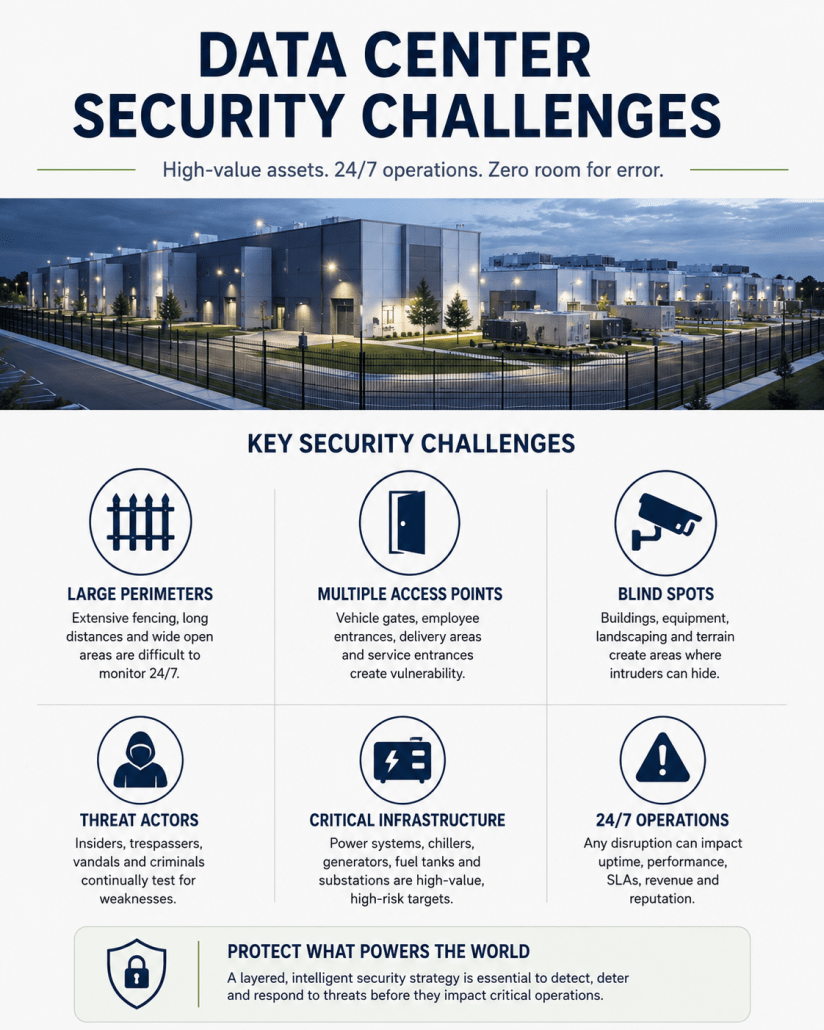
Limitations of traditional data center security approaches
Traditional security measures such as perimeter fencing, CCTV cameras, access control systems, lighting, and security patrols remain essential components of data center protection. However, each of these measures has limitations when used independently. Cameras may record an intrusion without preventing it, fences can be climbed or breached, and security personnel cannot continuously monitor every section of a large campus. Even well-designed surveillance systems can generate false alarms that require time to investigate.
Modern data centers require a security strategy that goes beyond simply detecting an intrusion. The objective is to identify suspicious activity as early and fast as possible, verify whether a genuine threat exists, and initiate a response before unauthorized individuals can gain access to critical infrastructure. As data center campuses continue to expand and operational demands increase, organizations are increasingly adopting layered perimeter security strategies that combine complementary technologies and response capabilities to provide continuous protection while minimizing false alarms and operational disruption.
K9 Tech Security Layered Security Approach
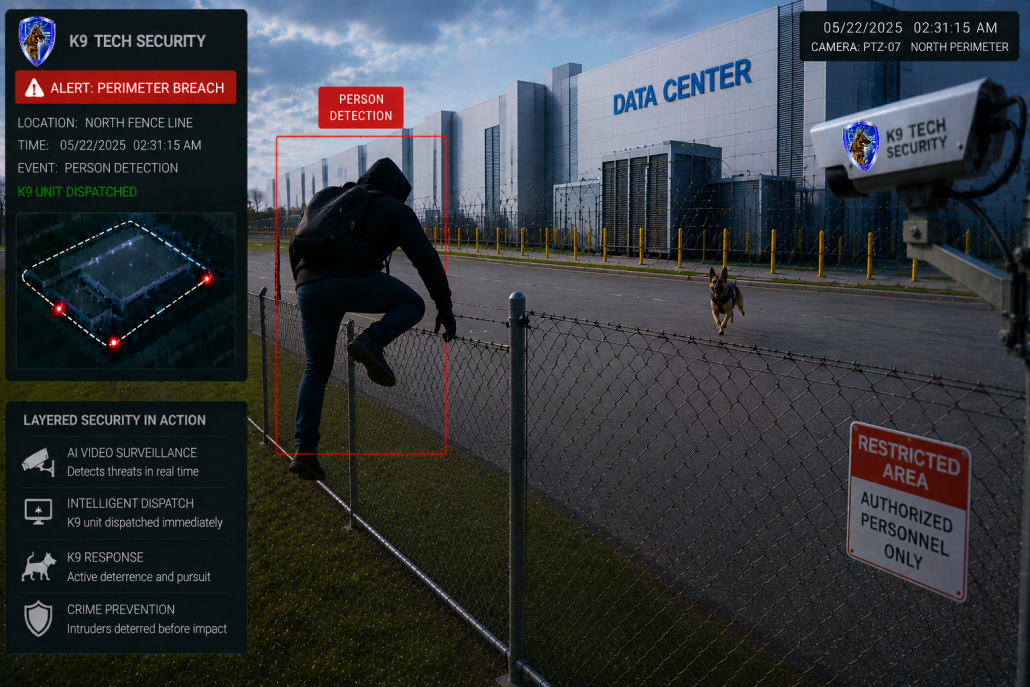
We are the only company offering a layered data center property site security. Our first layer is based on sophisticated AI video surveillance technology. Then we offer an active defense layer that can confront the threat in real-time. This is how our unique solution works:
- The AI surveillance system detects real threats — effectively eliminating many erroneous alerts.
- The AI surveillance management system alerts the owner, the assigned security operator, and our monitoring center.
- The AI monitoring system can also alert other violations, such as safety and policy violations by employees.
- The commercial property personnel have the option to activate automatically or manually on-site protection canines to counter the threat without having to wait for law enforcement to respond.
- The on-site K9 presents an effective deterrent for criminal elements to attack the site.
- This approach poses lower risk from a legal liability perspective than using armed guards.
- It is the most dependable solution for 24×7 monitoring and protection.
As AI drives unprecedented investment in data centers, protecting these facilities requires more than cybersecurity alone. Organizations that integrate cybersecurity with layered physical perimeter security are better positioned to protect their infrastructure, maintain operational resilience, and reduce the risk of physical and cyber-enabled attacks.
Click here for more information about K9 Tech Security Data Center solution. More details about our AI based video analytics system, and our K9 training program.
Leave a Reply
Want to join the discussion?Feel free to contribute!